
- HOME
- 石種の紹介
石種の紹介
ISHIMOでは、全国各地から厳選した国産の天然石を取り扱っています。●庵治石(あじいし)|香川県産 Aji Stone from Kagawa Prefecture


Aji stone is a granite found only in the Aji region in northeastern Kagawa Prefecture, and is a famous stone representing one of Japan's three major stone production areas. With its fine grain and beautiful luster, it is highly regarded, earning it the nickname "the diamond of granite." The unique mottled patterns on the stone's surface create a fantastical appearance when polished. It is extremely hard and durable, and does not absorb water easily, making it resistant to discoloration and deterioration even when used outdoors. It is widely used for stonework that demands high quality, such as sculptures, lanterns, and gravestones.
●安山岩(あんざんがん)|香川県小豆島産 Andesite from Shodoshima, Kagawa Prefecture
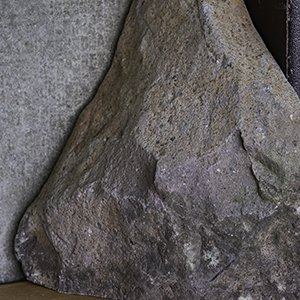

Andesite from Shodoshima was widely used for the stone walls of Nakayama Senmaida and the Inoshika fence. It is often used as a scenic stone in Japanese gardens, and is a popular stone used in its original form as andesite. The dark brown texture creates a luxurious feel. When cut, the surface is deep gray with a wood grain-like texture, creating a striking contrast with the surface.
●岡崎白石(おかざきしろいし)|愛知県産 Okazaki white stone from Aichi Prefecture


White stone (shiroishi) is produced in Okazaki City, Aichi Prefecture. It is a rare granite called "double mica granite" that contains both muscovite and biotite. Because it is an inexpensive and high-quality stone, it was previously used for stone carvings such as lanterns, but it is no longer quarried. Another reason for its popularity is that it is a relatively soft stone that is prone to moss growing on it.
●小呂石(おろいし)|愛知県産 Oro stone from Aichi Prefecture

小呂石は、愛知県岡崎市小呂町で採掘される上質な花崗岩です。硬質で彫刻や灯篭など幅広く使用されてきました。岡崎を代表する石材で、「三州みかげ」とも呼ばれています。
Oro stone is a high-quality granite mined in Oro Town, Okazaki City, Aichi Prefecture. Its hardness has led to its widespread use in sculptures, lanterns, and more. It is a stone representative of Okazaki, and is also known as "Sanshu Mikage."
●唐津石(からついし)|佐賀県産 Karatsu stone from Saga Prefecture


Karatsu stone is an andesite quarried in Karatsu City, Saga Prefecture. Because it is soft and easy to carve, it was widely used for sculptures and gravestones, mainly in northern Kyushu, until around the Showa era, but nowadays it has become a rare stone material due to the popularity of granite. Karatsu stone is characterized by its subdued brownish color.
●来待石(きまちいし)|島根県産 Kimachi stone from Shimane Prefecture


Kimachi stone is a tuffaceous sandstone quarried along the southern shore of Lake Shinji in Shimane. Also known as Izumo stone, it was formed from Volcanic ash around 14 million years ago. Used since ancient times for stone sculpture and craft, it is a historic stone material. Freshly cut, it has a bluish tone that gradually softens into a warm brown. It often gathers moss and blends naturally into gardens and scenery, adding a sense of calm and quiet depth.
●鞍馬石(くらまいし)|京都府産 Kurama stone from Kyoto Prefecture
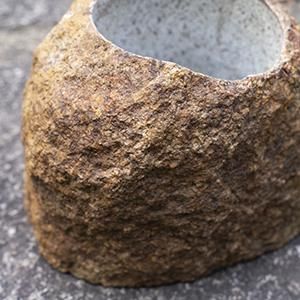

Kurama stone is a rare natural stone found in the sacred mountains of Kurama, Kyoto. Its surface develops a rusty brown tone through weathering. The warm color and texture harmonize beautifully with wabi-sabi, the Japanese aesthetic that finds depth in simplicity. It has long used for tea garden lanterns, water basins, stepping stones, and other stonework. It has quietly shaped the spiritual atmosphere of temples and shrines.
●白河石(しらかわいし)|福島県産 Shirakawa stone from Fukushima prefecture


白河石は福島県白河地方で産出する安山岩です。灰色がかった色味で、柔らかく落ち着きのある風合いが特徴の石材です。準硬石なので加工が容易で、古墳の石室や墓所、灯篭、石垣、石蔵などに使用されてきました。白河小峰城の石垣や、京都・桂離宮の石橋にも使用されています。四百年以上の歴史を持ちますが、埋蔵量が豊富で今後も安心して使える豊富な天然資源と言えます。
Shirakawa stone is an andesite found in the Shirakawa region of Fukushima Prefecture. It is a stone characterized by its grayish color and soft, calm texture. As a semi-hard stone, it is easy to process and has been used for stone chambers and graves in ancient tombs, lanterns, stone walls, and stone storehouses. It has also been used in the stone walls of Shirakawa-Komine Castle and the stone bridge of Katsura Imperial Villa in Kyoto. It has a history of over 400 years, but with abundant reserves, it is a rich natural resource that can be used safely in the future.
●白那智石(しろなちいし)|三重県産 White Nachi Stone from Mie prefecture


白那智石は、三重県熊野市に広がる七里御浜海岸で採取される希少な石種です。長い時間をかけて海の荒波にもまれたことにより、丸みを帯びた形をしています。自然環境の変化によって、現在では希少な石種となっており、許可を得た人だけが手で拾って採取します。上品な白さと、滑らかで光沢のある質感から、日本庭園のまき石、お寺や神社の境内の敷石など様々に用いられています。
White Nachi stone is a rare type of stone collected from the Shichiri Mihama coast in Kumano City, Mie Prefecture. Over a long period of time, it has been tumbled by the rough waves of the sea, resulting in its rounded shape. It is now rare, and only those with permission can collect it by hand. With its elegant white color and smooth, lustrous texture, it is used as pebbles in Japanese gardens and as paving stones in the grounds of temples and shrines.
●竜山石(たつやまいし)|兵庫県産 Tatsuyama stone from Hyogo Prefecture
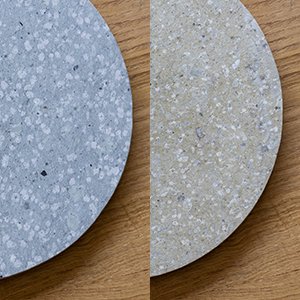

Tatsuyama stone is a tuff quarried inTakasago, Hyōgo. Formed when magma cooled in lake water, it has been valued for around 1,700 years. From ancient stone coffins and Buddhist statues to the walls of Himeji and Akashi Castles, it has long shaped Japan’s stonework tradition. Its pale blue and yellow tones stand out. When water-polished, the surface gains a soft, matte texture, creating a refined and gentle appearance.
●伊達冠石(だてかんむりいし)|宮城県産 Datekanmuri stone from Miyagi Prefecture


Datekanmuri Stone is an andesite quarried from Mt. Okura in southern Miyagi Prefecture. It is known as a high-quality stone with fine grain and one of the world's best compressive strengths. It is a rare stone with a high iron content, with an oxidized brown exterior and black interior. It is mainly used for sculptures and stone towers. With its beautiful contrast between the two colors and its one-of-a-kind appearance, Date Kan Stone has fascinated many artists. When polished, the black interior becomes visible, but over time it gradually oxidizes and changes to the color of iron rust. It is also characterized by its low moisture absorption and weathering resistance.
●那智黒石(なちぐろいし)|三重県産 Nachi black stone from Mie Prefecture

Nachi black stone is a famous stone characterized by its smooth surface due to its fine grain and deep black color. It is only mined in Kamikawa-cho, Kumano City, Mie Prefecture, and is known as a rare stone due to its limited production. It has excellent workability and has long been used for go stones and inkstones. Another attractive feature is that the more it is polished, the more its jet-black luster increases. Stones from Kumano are called "Honnachi black stone" and are clearly distinguishable from similar stones from other countries by the depth of the black color and the fineness of the stone's texture.
●夏山石(なつやまいし)|愛知県産 Natsuyama stone from Aichi Prefecture
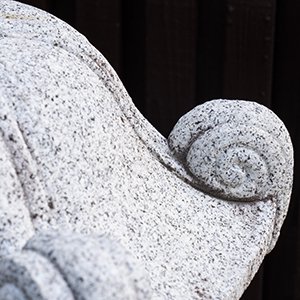
White granite has long been popular in Okazaki City, Aichi Prefecture, the city most famous for stone carving in Japan. It is called Natsuyama stone because it is mined in the Natsuyama area of ??Okazaki City. The stone is soft and sticky among granites, making it easy to carve into intricate details, and is often used for lanterns and stone Buddha statues in the Chubu region. It can also be mined in large, long shapes, so it is also used for torii gates and stone monuments. It is said to absorb water easily, but when it comes to lanterns, moss easily grows on them, so it blends in with the garden and gives off a stone texture.
●額田中目石(ぬかたちゅうめいし)|愛知県産 Nukata chume stone from Aichi Prefecture
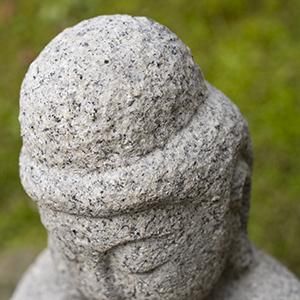

This is a domestic granite that has long been used for sculptures, gravestones, and landscaping in Aichi Prefecture, which is famous for stone carving. It is characterized by its beautiful fine grain and hardness. It is said to have the best toughness in the world. As a result, it is considered a stone material that is particularly suitable for fine carvings.
●花沢石(はなざわいし)|愛知県産 Hanazawa stone from Aichi Prefecture


Hanazawa stone is a granite quarried from Mount Rokusho in Hanazawa, Aichi. Long valued as a representative light-colored granite of the region, it has been widely used for gravestones and sculptural works. Its balanced hardness and natural toughness make it well suited for fine carving, including stone pagodas and Buddhist statues. With a dense grain and low water absorption, it offers durability and a smooth, elegant polish.
●蛭川錆石(ひるがわさびいし)|岐阜県産 Hirugawa rust stone | Gifu Prefecture


Hirugawa sabi stone is a granite quarried in the Hirugawa area of Nakatsugawa, Gifu. It has long been widely used for architecture, torii gates, stone markers, and sculpture. Rare among granite, it features warm rust tones with hints of yellow and red, sometimes patterned with white. The natural contrast of minerals and iron creates depth and warmth that endure over time.
●福田石(ふくだいし)|香川県小豆島産 Fukuda stone from Shodoshima, Kagawa Prefecture

Fukuda stone is a granite quarried on Shodoshima Island, Kagawa. Its surface features a distinctive mix of pale white and rusty tones. Known as a “treasure island of stone,” Shodoshima was formed when massive granite, slowly cooled deep underground, was uplifted by tectonic movement around 80 million years ago. Fukuda stone remains one of the island’s signature materials, still quarried and worked locally as a high-quality granite.
●真壁石(まかべいし)|茨木県産 Makabe stone from Ibaraki Prefecture


Makabe stone is a granite quarried in the Makabe region of Ibaraki. Formerly known as “Hitachi komikage,” it has been valued mainly in Kanto region and was even used in historic buildings such as the Akasaka Palace. Known for its fine grain and stable color, Makabe’s stoneworking tradition began over 500 years ago with Buddhist sculpture and continues today as a major center of stone craft.
●万成石(まんなりいし)|岡山県産 Mannari stone from Okayama Prefecture


Mannari stone is a granite produced in Okayama Prefecture. It is characterized by its gorgeous and elegant pale pink color and is also known as "Sakura Granite." It is a hard, durable stone that does not absorb water easily. It is considered to be an auspicious stone that brings eternal success. It is often used in the Shinjuku Isetan Building, Okayama Prefectural Museum of Art, and the graves of famous people.
●みはま小石(みはまこいし)|三重県産 Mihama Pebbles from Mie Prefecture

Mihama pebbles are collected from the Shichiri Mihama coast in Kumano City, Mie Prefecture. Collecting the stones or using heavy machinery is prohibited for the general public; only those with permission are allowed to collect them by hand. Over long periods, the pebbles are weathered by the rough waves of the sea, resulting in rounded edges and a smooth texture. Enjoy the unique colors, patterns, and smooth texture created by the power of nature.
●八女石(やめいし)|福岡県産 Yame stone from Fukuoka prefecture


Yame stone is a tuff quarried in Yame, Fukuoka?an area famous for tea. It was formed about 70,000 years ago from volcanic ash of a massive eruption of Mount Aso. Its surface features distinctive patterns, with yellow pumice and dark obsidian lenses mixed within. Lightweight and porous, yet resistant to fire and cold, it is easy to carve and has been used for lanterns, Buddhist statues, and stone pagodas. Over time, moss gathers naturally, deepening its quiet character.
●由良石(ゆらいし)|香川県産 Yura stone from Kagawa prefecture


Yura stone is a biotite andesite that was mined from Mt. Yura in Yura-cho, Takamatsu City, Kagawa Prefecture. Known as a high-quality stone since the Edo period, it is easy to process and is heat-resistant. It has been highly praised for the fact that it puts less strain on the feet when laid on cobblestones, and in 1966 it was adopted as the paving stone for the East Garden of the Imperial Palace (Palace Square). It has also been used in public buildings and cultural facilities across the country, but it is a precious stone that cannot be quarried today.
